An engine with a changing wiring diagram
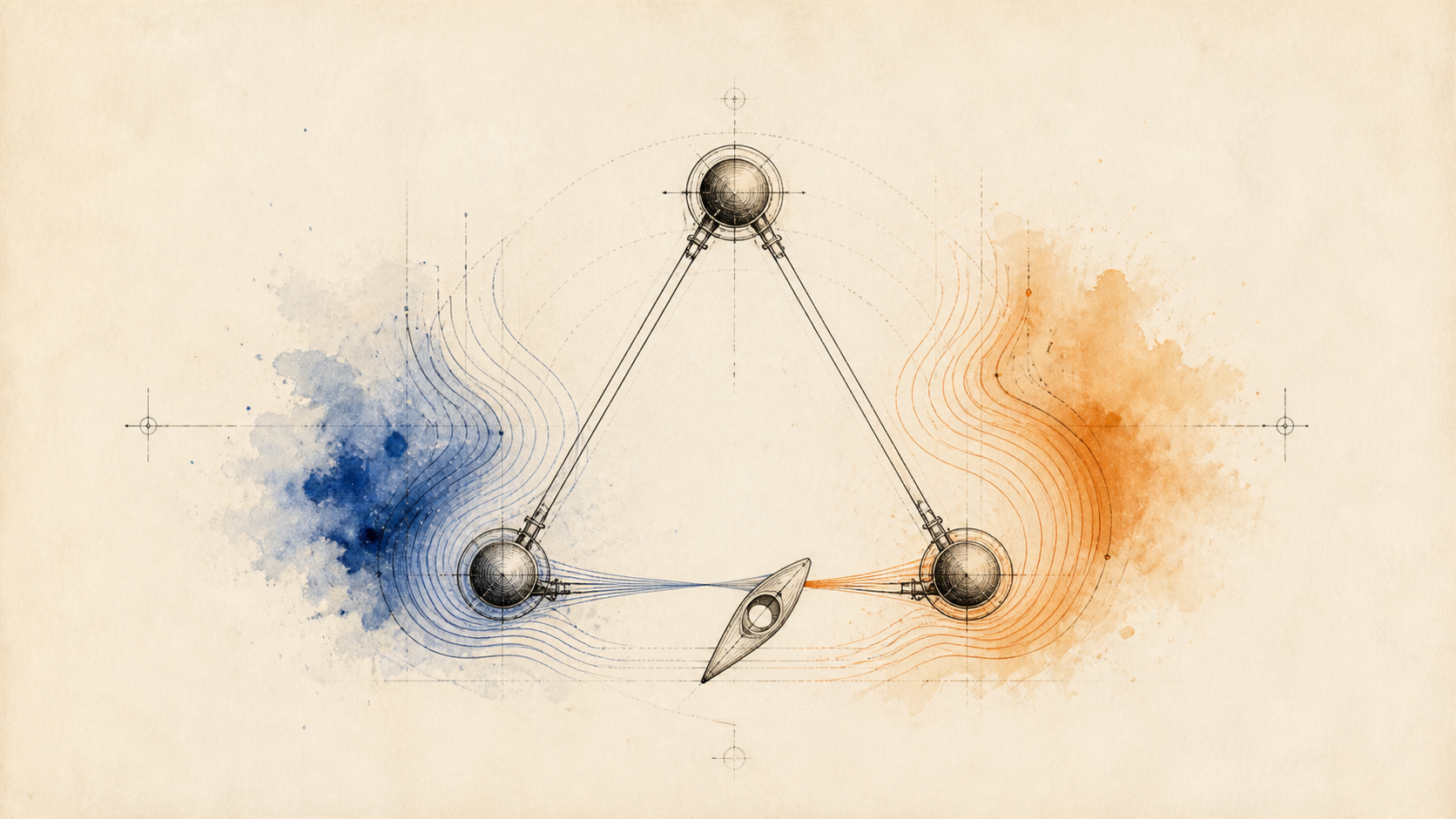
What if a heat engine changed not the size of its container, but the list of forces holding its particles together? The new study builds such a cycle on paper. Its working substance is a small network whose links can be inserted, removed and allowed to exchange heat.
The clean example uses three particles moving in a plane. Two links first form an open chain. A third link closes the triangle, changing every particle's force landscape at once because the confinement depends on the network's total strain.
For one sudden link change, the full work distribution remembers the original network through a single number called effective resistance. That compression is the result's surprise. A global web of interactions enters one nonequilibrium operation through one local-looking graph distance.
RO-2026-0005:C6From slow energy diffusion to controllable engines
In 1940, Hendrik Kramers showed how a weakly damped system's energy can wander slowly while its mechanical motion remains fast. That energy-diffusion picture became foundational for reaction rates. It did not provide the present accounting of driven work, heat, entropy and network topology.
In 1991, Stephan Linkwitz and Hermann Grabert studied a weakly damped driven well. In 1992 and 1993, Christopher Jarzynski developed energy diffusion for slowly driven ergodic systems and chaotic billiards. Those advances treated driving, but did not combine this thermal current with the network engine built here.
In 2016 and 2019, Domingos Salazar and Sérgio Lira made the same slow-energy logic concrete for highly underdamped trapped particles. They obtained exact relaxation and nonharmonic results, including an effective count of thermodynamic degrees of freedom. Their solved systems did not yet turn graph rewiring into an engine.
In 2022, Y. H. Chen and colleagues built a microscopic Brownian route to Curzon–Ahlborn performance. Jin-Fu Chen and Hai-Tao Quan added a constrained maximum-power analysis in 2024. Those are the closest engine precedents; the new construction instead makes a nonlinear many-particle interaction network itself the control.
RO-2026-0005:C1RO-2026-0005:C2RO-2026-0005:C4The theorem boundary — when total energy is enough
The theorem begins in a highly underdamped regime. Each mechanical orbit must be much faster than damping and control, and the motion must sample an energy shell well enough that total energy behaves as a closed random variable. Without that separation, the one-coordinate description can fail.
A second restriction supplies solvability. The confining energy must scale by one power when every position is rescaled. Within this homogeneous family, one parameter fixes thermal size, heat capacity and fluctuation strength, while another fixes the rate of relaxation and therefore the clock for power.
This distinction prevents a common shortcut. Two systems can share equilibrium energy statistics yet relax at different rates. The paper keeps the thermodynamic size and kinetic clock separate, then asks which conclusions survive when independent particles are replaced by an interacting graph.
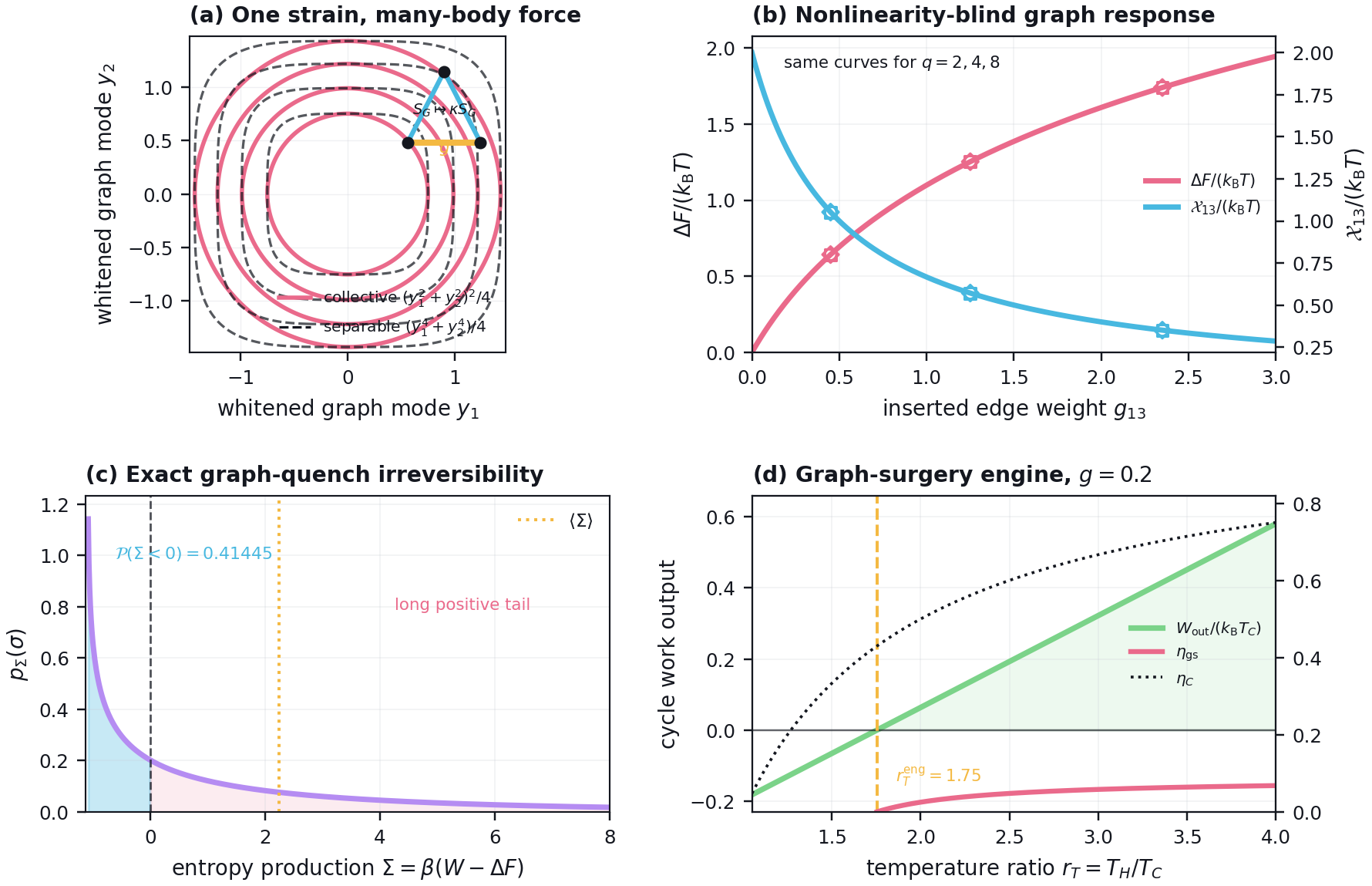
The graph cage answers that question with a synthetic collective potential. It first adds the squared separations along every weighted link. It then raises that total strain to a common power, so stretching one link changes the restoring force transmitted through all the others.
For one sudden edge change, an entire network enters the work law through a single effective resistance.
RO-2026-0005:C1RO-2026-0005:C7RO-2026-0005:C2RO-2026-0005:C5RO-2026-0005:C6Proof intuition — how a network becomes one number
Picture a road map in which effective resistance measures how many weighted detours connect two junctions. Adding a direct road matters less when many good alternatives already exist. The mathematical quantity plays the same bookkeeping role here, although no electrical current or traffic is part of the physical model.
The proof changes coordinates until the network's distorted energy shells become round. Their volume then splits into a radial factor and a graph factor. A standard rank-one update shows how that graph factor changes when a single link is altered.
The radial part says how much energy the cage carries. The angular part says how much of the configuration points along the edited link. These two random pieces become independent, producing an exact work law for any positive homogeneity power and any connected starting graph.
That law is stronger than a mean-work formula. It yields every work moment and recovers the Jarzynski and Crooks fluctuation relations. Yet it remains sharply scoped—the link must change suddenly while positions and momenta are effectively frozen.
RO-2026-0005:C5RO-2026-0005:C6An exact distribution of work and irreversibility
The paper works out the most vivid case in full. Three planar particles begin as a path, and the missing link is inserted with unit weight. The collective confinement grows as the fourth power of distance, making the force genuinely nonadditive rather than three independent springs in disguise.
In that quench, the work is always nonnegative because the added link tightens the cage. Irreversibility compares that work with the equilibrium free-energy increase. On about 41 percent of trajectories, the work falls below that increase and the stochastic entropy production is negative.
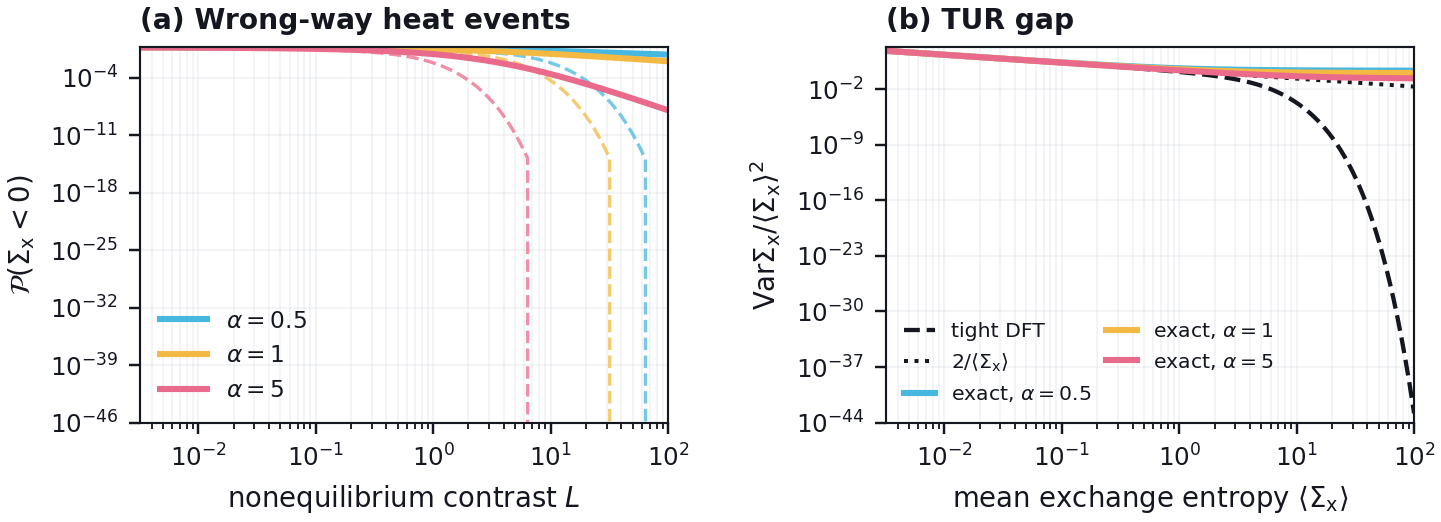
Those events are apparent second-law violations, not failures of the second law. A long positive tail keeps the average entropy production nonnegative, and the exponential fluctuation identity remains exact. The full distribution shows why an average alone can hide much of the process.
Once the new triangle is allowed to thermalize, the extra energy drains as heat. The study gives the relaxation law and the joint statistics of insertion work and later heat. Mixed fluctuations that are usually treated separately can therefore be generated from one closed expression.
The same framework also sharpens a broader uncertainty lesson. For thermal exchange in the homogeneous family, the usual current bound is satisfied but can sit far below the exact noise. The paper replaces that loose comparison with an identity whose finite-size gap is controlled solely by thermodynamic size.
RO-2026-0005:C6RO-2026-0005:C3Thermodynamic scope — four strokes of graph surgery
Now the rewiring becomes a cycle. Insert the missing link while the open chain is equilibrated with a cold bath. Heat the closed triangle, remove the link after hot equilibration, then cool the restored path. The force network returns to its starting topology after four strokes.
Above an explicit temperature-ratio threshold set by link strength, the cycle delivers net work. Its efficiency remains below the Carnot ceiling because the mean entropy production is nonnegative. The result includes the mean heats, work variance and the complete cycle-work transform.
This is a topology-changing engine, but not a claim that rewiring always beats compression. Its value is exact solvability. It exposes how a discrete structural operation can become a thermodynamic control with calculable fluctuations, rather than only a change in equilibrium free energy.
Complete equilibration between link changes is essential to the closed cycle formulas. Shorter contacts would preserve memory between strokes and correlate the two surgeries. Then total energy alone no longer carries every needed variable, and the angular sector must travel with it.
RO-2026-0005:C6RO-2026-0005:C7Six cycles, six different constraint sets
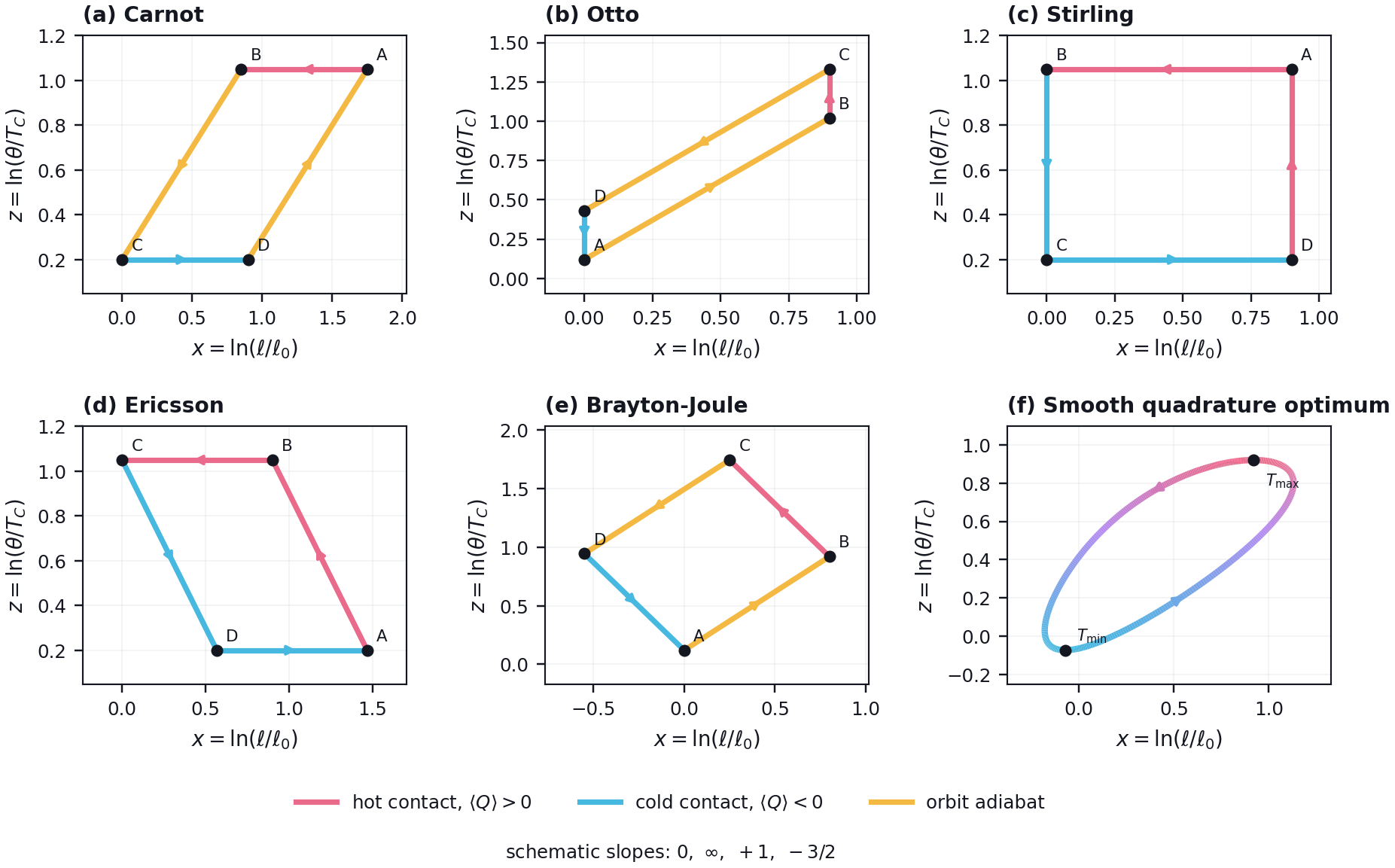
The paper places this engine beside Carnot, Otto, Stirling, Ericsson and Brayton–Joule cycles, plus a smooth optimized loop. The comparison makes one methodological point—constraints select architecture. Optimizing stroke timing, pressure ratio or a smooth control budget answers different questions and can produce different celebrated efficiencies.
The cycle atlas is therefore not a beauty contest among engine names. It separates imposed topology from continuous optimization. Even the smooth loop is globally optimal only inside its declared fixed-period function space and experimental budgets.
RO-2026-0005:C4Classical checks, not an experiment
The release tests the analytic claims with classical computation. Independent checks reproduced the edge-work mean and variance, the free-energy relation, the forward–reverse fluctuation symmetry and the roughly 41 percent negative-production probability without sampling from the asserted factorization.
A separate offline reconstruction reran the scientific validators in a network-disabled, read-only container. The smooth-cycle equality, exchange uncertainty identity, graph update and hard-sphere consistency checks all passed. These are reproducibility results, not laboratory measurements.
RO-2026-0005:C6RO-2026-0005:C3RO-2026-0005:C4RO-2026-0005:C8Limitations and the experimental frontier
The largest limitation is also the next experimental problem. The graph cage is a proposed synthetic interaction, not a realized device in this release. Feedback traps and tunable multiparticle platforms motivate it, but controller delay, bandwidth and measurement noise would add scales absent from the exact model.
Generic finite-rate rewiring also breaks the simplest energy-only closure unless shell mixing is fast enough or extra angular observables are retained. The hard-sphere and mean-field fluid extensions elsewhere in the paper are conditional reduced models, not microscopic convergence proofs.
Return to the road map. For one sudden new road, effective resistance can summarize the whole network's response. During continuous reconstruction, the traffic pattern matters too. The exact result is powerful because it marks both sides of that boundary.
Correspondent v0.2 prepared this Story from immutable Research Object RO-2026-0005, with its DOI linked on the source record. The public record names Maestro v0.1 as scientific creator and Domingos S. P. Salazar as Program Manager. The Story explains the release without changing its claims.
The cycle does not squeeze a piston. It rewires the force landscape.
RO-2026-0005:C6RO-2026-0005:C7RO-2026-0005:C8RO-2026-0005:C1Open the paragraph-level evidence register
Every material assertion is bound to accepted claims and evidence in the immutable source release.
RO-2026-0005:C6RO-2026-0005:C6RO-2026-0005:C6RO-2026-0005:C1RO-2026-0005:C1RO-2026-0005:C2RO-2026-0005:C4RO-2026-0005:C1RO-2026-0005:C7RO-2026-0005:C2RO-2026-0005:C2RO-2026-0005:C5RO-2026-0005:C5RO-2026-0005:C6RO-2026-0005:C5RO-2026-0005:C6RO-2026-0005:C5RO-2026-0005:C6RO-2026-0005:C6RO-2026-0005:C6RO-2026-0005:C6RO-2026-0005:C6RO-2026-0005:C6RO-2026-0005:C6RO-2026-0005:C3RO-2026-0005:C6RO-2026-0005:C6RO-2026-0005:C6RO-2026-0005:C6RO-2026-0005:C7RO-2026-0005:C4RO-2026-0005:C4RO-2026-0005:C6RO-2026-0005:C3RO-2026-0005:C4RO-2026-0005:C6RO-2026-0005:C8RO-2026-0005:C6RO-2026-0005:C7RO-2026-0005:C8RO-2026-0005:C6RO-2026-0005:C7RO-2026-0005:C1