What sets the order?
A row of quantum spins can lose a stronger initial directional bias faster than a weaker one. The timing depends on where you look: a crossing, in which two preparations reverse their asymmetry ranking, can occur later for small groups near the ends than in the middle. What sets that order, and can it be changed?
The signal is called entanglement asymmetry. It measures how much a subsystem's state distinguishes directions around a chosen spin axis. A zero value means rotating that part about the axis leaves its state unchanged. The quantum Mpemba effect occurs when two preparations reverse their ordering under this measure.
Large-subsystem theory had already linked this ordering to magnetization fluctuations in long-range chains. The new Pudim Letter asks what survives for small blocks, where individual excitation counts matter. It separates the loss of phase alignment from the flow of spin excitations across a block's boundary.
RO-2026-0009:C5RO-2026-0009:C6RO-2026-0009:C2RO-2026-0009:C3RO-2026-0009:C4From a signal to a mechanism
In 2023, Filiberto Ares, Sara Murciano and Pasquale Calabrese introduced entanglement asymmetry as a probe of symmetry breaking. Their work established a way to study local symmetry restoration and its counterintuitive ordering. It did not supply the finite-block transport analysis developed here.
In 2024, Joshi and colleagues observed the quantum Mpemba effect in a physical twelve-ion simulator. Crossings near the ends occurred later, and changes to the dynamics could suppress the effect. Those observations established an experimental setting while leaving the boundary delay to be understood more fully.
In 2026, Shion Yamashika and Filiberto Ares connected long-range crossings to magnetization fluctuations and obtained a crossing-time law for large subsystems. This is a close theoretical precedent. The new Letter adds finite-block ordering results and follows the redistribution of spin excitations through space.
RO-2026-0009:C2RO-2026-0009:C5RO-2026-0009:C3Two changes inside one chain
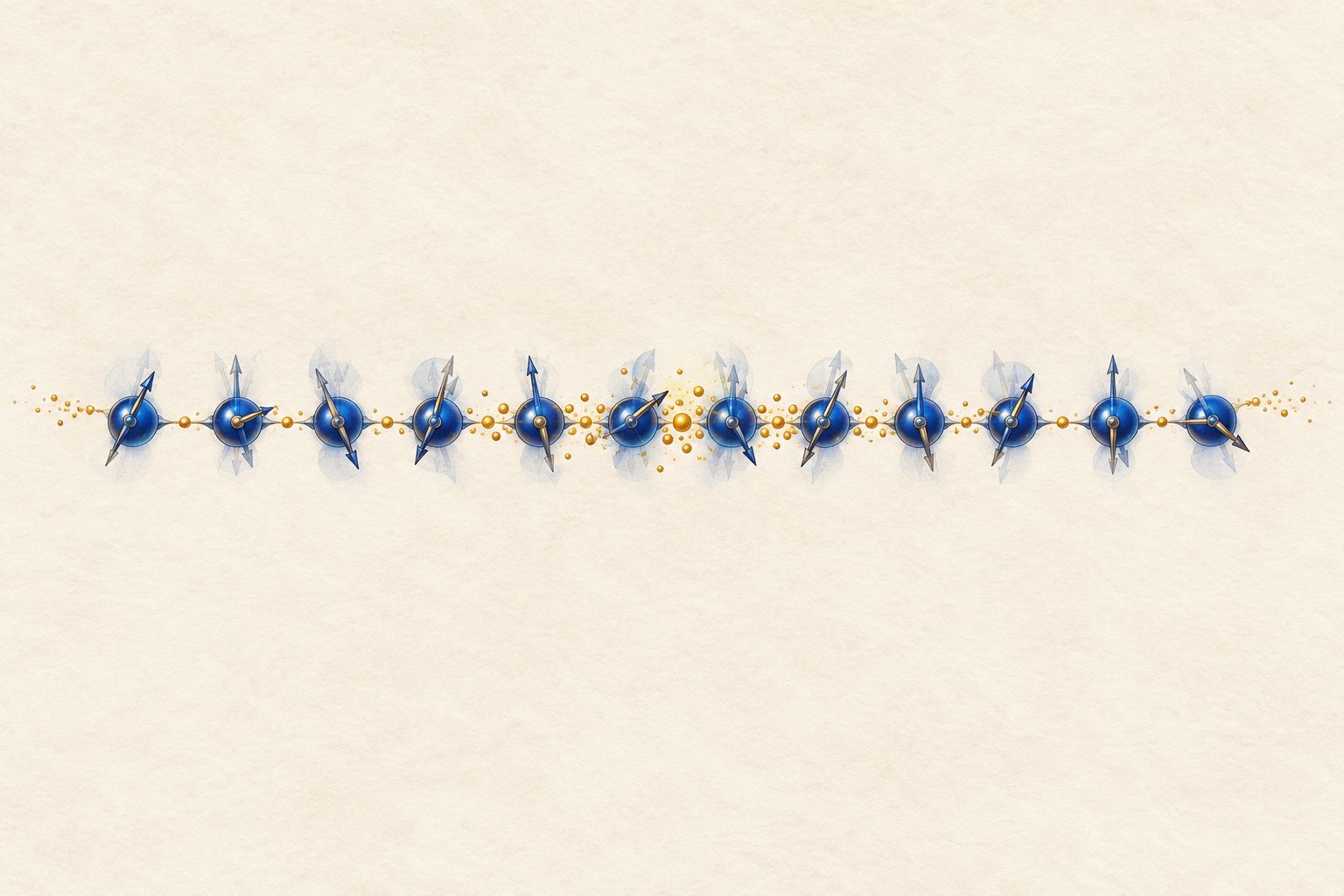
The illustration separates two changes. Blue compass needles suggest spin phase orientations spreading apart; gold dots suggest excitation counts shifting along the chain. The needles and dots are visual analogies. Actual quantum states also carry correlations beyond this picture.
An excitation here means a spin pointing up relative to the chosen axis. The paper calls their count charge. Excitations can move between sites while the trapped ions stay in place. A small block can therefore gain or lose excitations even though the whole chain conserves their total number.
Phase alignment can fade while those counts stay fixed. But a fading single-ion signal can also reflect a changing local excitation population. The Letter proves an exact separation of these contributions at second order in time, a short-time result for the spin-exchange model it studies, including irregular coupling networks.
RO-2026-0009:C4When crossings are possible
One theorem starts with every spin pointing in the same direction, tilted away from down by at most a quarter turn. Both preparations have a nonzero tilt, and the block's excitation-count distribution stays fixed. All spins in the block share a random phase shift drawn from a bell-shaped Gaussian distribution. If that spreading has the same strength for both tilts, the asymmetries stay ordered and cannot cross.
Under the Letter's stated tilt-dependent law, with any additional background phase spreading held fixed, the asymmetries become equal at a finite value of the tilt-dependent spreading strength. A physical evolution must actually reach that threshold. Continuous growth can saturate below it, so the existence result alone does not guarantee a crossing in time.
RO-2026-0009:C2RO-2026-0009:C3Why a threshold appears
The proof compares contributions from different excitation counts. Phase spreading suppresses coherence between those counts, and the larger tilt can suppress it faster. The asymmetry difference starts positive and eventually becomes negative as the model's dephasing parameter grows. Continuity then gives an equality between those limits.
RO-2026-0009:C3What the ion records show
The Letter returns to the public twelve-ion records and resolves excitation depletion near the ends and accumulation toward the centre. That redistribution accompanies the later end-block crossings. The short-time identities explain how coupling geometry can drive this flow, while the ideal model accounts for only part of the measured delay.
The measurement-assisted estimate uses changing block excitation counts and a conversion from single-ion phase signals; the simplest rule instead keeps the initial count distribution and uses a simpler phase calibration. On experimental cases where both can be evaluated, their crossing-time estimates remain statistically indistinguishable. Some resampled end-block records have no crossing. Five of twelve end cases consequently lack complete uncertainty estimates for the measurement-assisted comparison.
RO-2026-0009:C4RO-2026-0009:C5RO-2026-0009:C6RO-2026-0009:C7Changing the order in a model
In the ideal twelve-ion model, the authors apply one prescribed pattern of local fields to both preparations. For one pair, the end and central crossing times change from about 2.28 and 1.19 milliseconds to 1.48 and 1.66 milliseconds. The end blocks now cross before the central blocks.
The second tested pair keeps its end delay. These are classical calculations of quantum dynamics; the Letter reports no new hardware test of the field control. The field changes phase evolution as well as excitation flow, so the comparison does not isolate an experimentally measured share caused by transport.
The release also analyses saved classical simulations of a 51-ion chain. Changing how the experimental coupling profile is reconstructed shifts the predicted crossings. Those shifts show sensitivity to the model; they do not establish a calibrated uncertainty range for the physical chain. Multi-tilt crossings in that chain remain unmeasured here.
The measurement-assisted estimate was checked across 719 selected evaluations from the studied simulations. Its median absolute discrepancy was about 0.06 milliseconds. These evaluations share simulation data and are statistically dependent. The estimate fails in a separately reported shorter-range end regime.
RO-2026-0009:C6RO-2026-0009:C9RO-2026-0009:C8What relaxation means here
The relaxation comparison concerns remnants of the prepared directional bias inside a subsystem. This work studies symmetry restoration in a quantum spin chain. Cooling temperatures, heat-engine work and thermodynamic efficiency lie outside its studied scope.
RO-2026-0009:C2RO-2026-0009:C3RO-2026-0009:C4What the estimate still needs
The estimate needs the distribution of excitation counts in each block at each test time. It also needs single-ion coherence measurements from three initial tilts under the same couplings. Turning those phase-sensitive signals into a block estimate uses an empirical conversion.
The theory does not yet provide a test that tells an experimenter beforehand whether that conversion will work. The exact short-time separation also does not control the whole evolution up to a crossing. The successes support a bounded measurement method with unresolved applicability.
RO-2026-0009:C7RO-2026-0009:C4A test for the next race
A direct experiment could test the predicted reversal of crossing order. A useful next theoretical step would identify when the measurement conversion is reliable. The compass picture leaves a practical lesson: understanding fading quantum order also requires watching how excitation counts change in the part being measured.
RO-2026-0009:C6RO-2026-0009:C7Open the paragraph-level evidence register
Every material assertion is bound to accepted claims and evidence in the immutable source release.
RO-2026-0009:C5RO-2026-0009:C6RO-2026-0009:C2RO-2026-0009:C3RO-2026-0009:C2RO-2026-0009:C4RO-2026-0009:C2RO-2026-0009:C5RO-2026-0009:C3RO-2026-0009:C4RO-2026-0009:C4RO-2026-0009:C4RO-2026-0009:C2RO-2026-0009:C3RO-2026-0009:C3RO-2026-0009:C4RO-2026-0009:C5RO-2026-0009:C6RO-2026-0009:C5RO-2026-0009:C7RO-2026-0009:C6RO-2026-0009:C6RO-2026-0009:C9RO-2026-0009:C8RO-2026-0009:C2RO-2026-0009:C3RO-2026-0009:C4RO-2026-0009:C7RO-2026-0009:C4RO-2026-0009:C7RO-2026-0009:C6RO-2026-0009:C7