From analog dials to quantum detectors
In 1951, Philip Panter and William Dite studied a problem created by the new digital age: how could a smoothly varying signal be translated into a limited set of symbols without throwing away the part people cared about? Later work by Joel Max and Stuart Lloyd turned that practical puzzle into a durable mathematical recipe called quantization.
The basic idea is familiar whenever a continuous world meets a finite display. A thermometer rounds a temperature. A digital photograph turns shades of light into numbered colors. A subway map removes most of a city so that a traveler can see the routes that matter.
Quantum sensors now face a strangely similar problem. They are built to register tiny changes—a weak field, a small temperature shift, a slight change in phase. Quantum theory can say how sensitive the best possible measurement would be. But the recipe for that perfect measurement may end with an absurdly crowded display: in a system of n quantum bits, it can call for as many as 2ⁿ distinct outcomes.
RO-2026-0001:C2RO-2026-0001:C1What a measurement is trying to say
A sensor does not reveal its target directly. It produces clicks, flashes or numbers whose probabilities change when the target changes. A useful measurement is one in which those probabilities move noticeably even when the underlying field or phase moves only a little.
Physicists summarize that responsiveness with Fisher information. More Fisher information means that repeated readings can pin down the unknown quantity more sharply. Quantum Fisher information is the ceiling: the most responsiveness that any allowed measurement could extract at a chosen operating point.
Knowing the ceiling, however, is not the same as building the staircase. The mathematically optimal readout is defined by an object called the symmetric logarithmic derivative. Its name is forbidding, but the practical problem is simple: its many possible outcomes may each be assigned a number telling us how strongly that outcome points toward a change in the quantity being measured.
RO-2026-0001:C1The street map hidden in the spectrum
Imagine asking for directions across a city and receiving a complete list of every paving stone. The answer is exact, but useless. A transit map succeeds by merging streets and stations that play the same role in a journey. It keeps the distinctions that change where you go and discards the ones that do not.
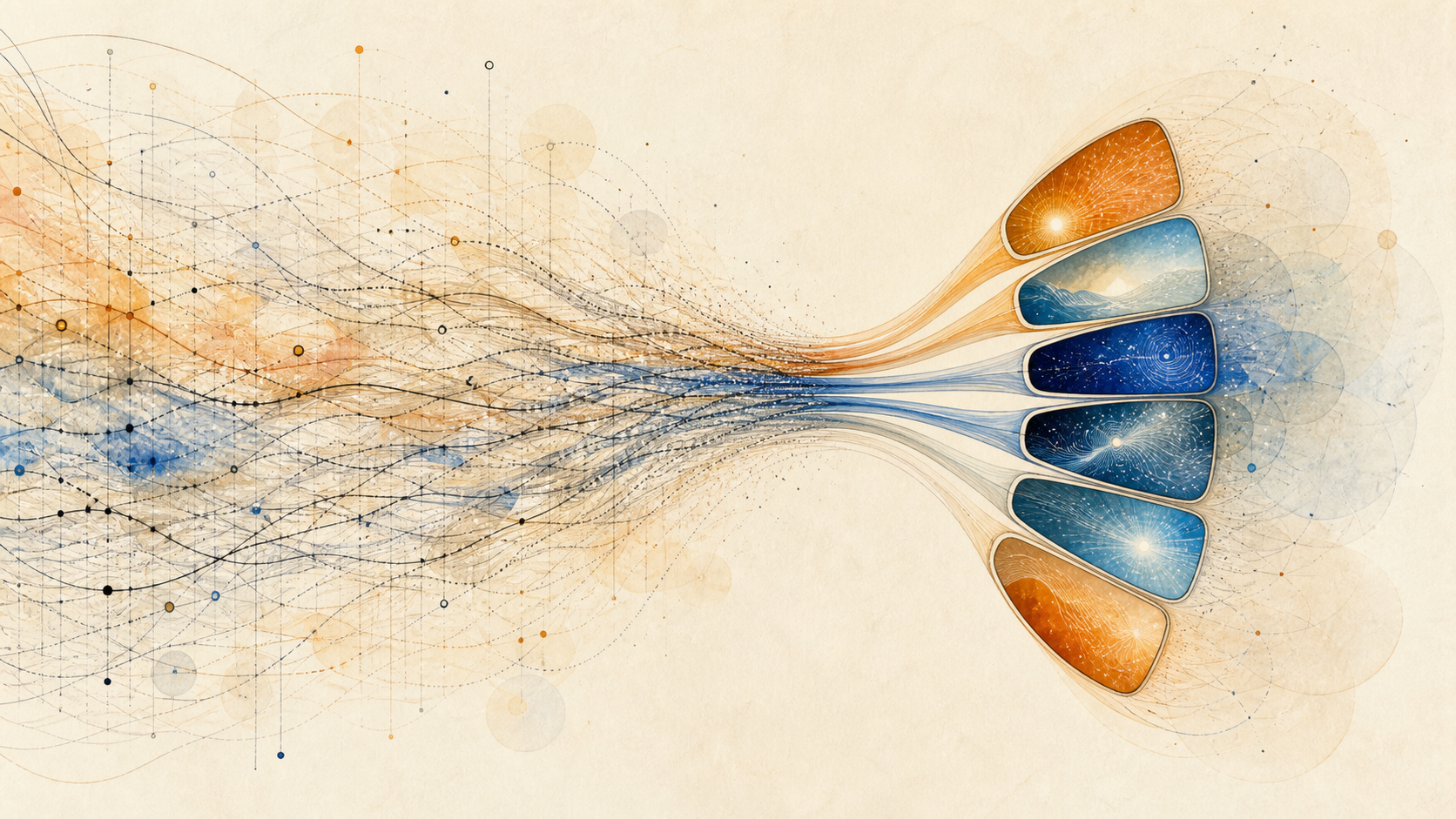
The paper applies that same logic to a quantum readout. Each outcome carries a score—not a grade, but a measure of how its probability changes. Two outcomes with nearly the same score carry nearly the same local news. Put them in the same detector bin, and the readout forgets which one occurred while preserving most of what the sensor was trying to say.
The crucial step is that the cost of this forgetting can be calculated exactly. Within each bin, the loss is controlled by how widely the scores are spread. Tight groups lose little. Rare, extreme scores can be sent to a pair of tail bins. The resulting guarantee does not deteriorate merely because the underlying quantum state occupies a larger space.
This is where the old theory of quantization reappears in quantum clothing. The problem of choosing a few score bins is mathematically akin to choosing a few representative levels for a continuous signal. And when the spectrum actually contains only finitely many distinct scores, the loss eventually falls all the way to zero: give every distinct score its own stop on the map, and nothing is forgotten.
A detector does not need to remember every road if several roads carry the same news.
RO-2026-0001:C1RO-2026-0001:C4RO-2026-0001:C2A small-system stress test
The research package tests the idea on a simulated sensor made from four interacting quantum spins. In the best restricted product measurement found by its archived search, the detector recovered 48.55 percent of the available quantum Fisher information. Grouping the outcomes of the ideal score measurement into seven bins retained 98.34 percent; eight bins retained 99.26 percent.
Those numbers are not a universal promise for quantum sensors. They belong to one declared model, one operating point and one optimization procedure. The four-spin example is a stress test in software, not a laboratory demonstration. Its role is to make the central separation visible: a coarse list of answers can preserve far more information than a physically simple measurement happens to collect.
RO-2026-0001:C7The small sign and the big machine
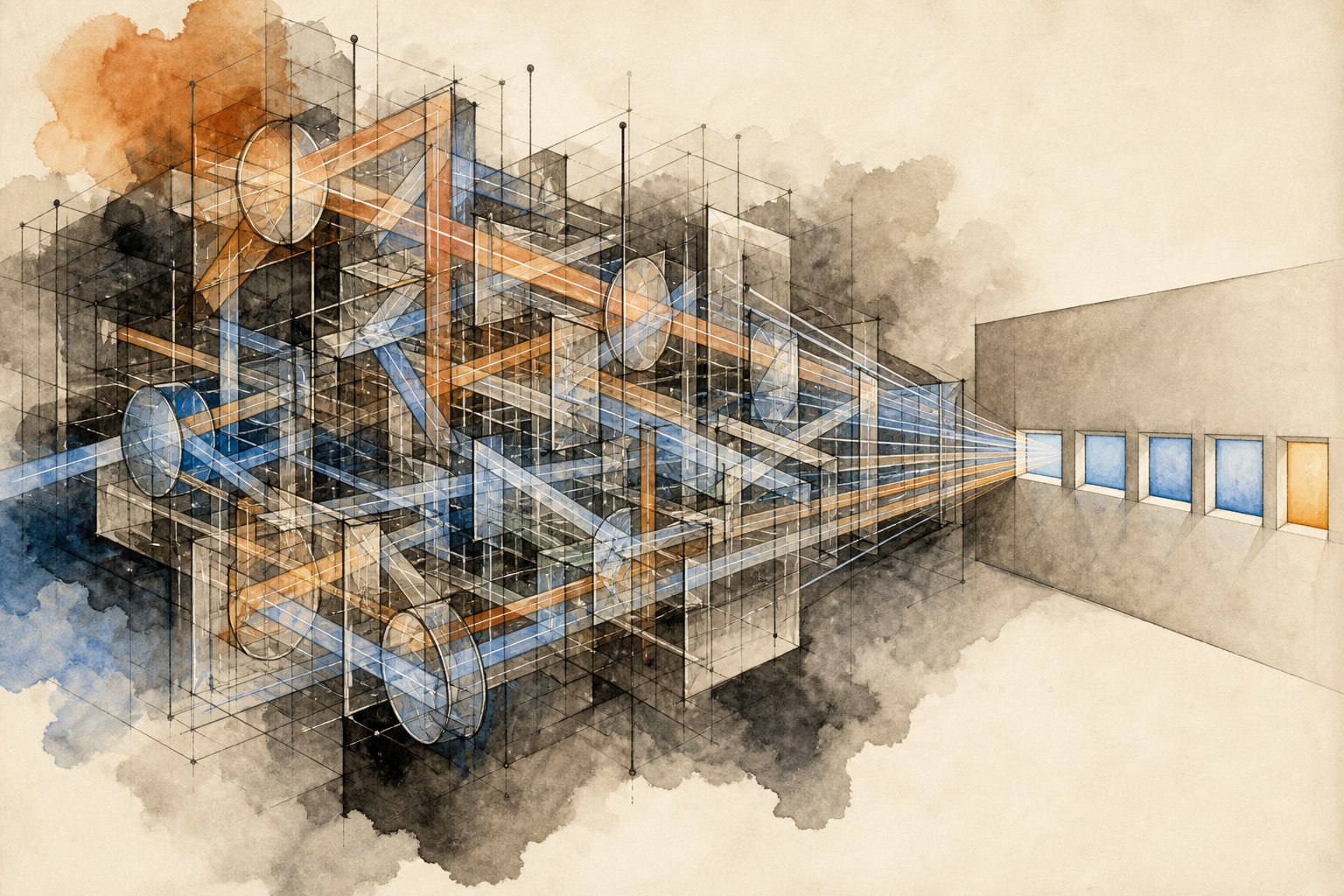
Now comes the twist. A subway map may be simple even when the tunnels beneath the city are not. In the same way, a detector can show only seven labels while relying on an intricate quantum process to route the incoming state to the correct one.
The paper therefore separates two kinds of complexity. Output complexity asks how many answers the detector must display. Implementation complexity asks what machinery is needed before one of those answers can appear. Compressing the first does not automatically compress the second.
For some specially constructed quantum families, the work shows that building the coherent routing process is computationally hard under a precise access model. The statement is intentionally narrow. It does not say that every quantum measurement is hard, that ordinary sampling is hard, or that the four-spin benchmark demonstrates a quantum advantage.
There are friendlier families too. In one structured sensing model, a system with n quantum bits has only n + 1 exact scores, so the label register grows slowly even as the sensor grows. Structure can turn the hidden street plan into something navigable. The research question is to recognize when that happens—and when a small public map still conceals a vast underground network.
RO-2026-0001:C4RO-2026-0001:C5RO-2026-0001:C6Why this matters now
Quantum metrology is often introduced through its destination: better clocks, field sensors, interferometers and spectroscopic measurements. But a destination is not a route. Calculating the ultimate sensitivity of a device does not establish that an experiment can reach it with realistic controls, finite resolution and tolerable resources.
This work offers a vocabulary for avoiding that leap. First ask how much information survives when similar outcomes are merged. Then ask, separately, whether the required bins can be produced by an implementable measurement. A claim about the display should not be mistaken for a claim about the machine behind it.
The distinction also defines what remains undone. The paper gives exact compression guarantees, a scoped hardness result and reproducible small-system examples. It does not provide a completed hardware compiler, a full resource estimate or a general experimental speedup. Those are not footnotes; they are the next part of the story.
The old quantization problem asked how to say enough with a small alphabet. Quantum sensing adds a second question: how hard is it to make nature speak that alphabet in the first place? The new result does not collapse those questions into one. It gives us a cleaner map—and warns us that the tunnels may still be the hard part.
A shorter answer can still require a very complicated machine to produce it.
RO-2026-0001:C4RO-2026-0001:C6RO-2026-0001:C1RO-2026-0001:C5RO-2026-0001:C7Open the paragraph-level evidence register
Every material assertion is bound to accepted claims and evidence in the immutable source release.
RO-2026-0001:C2RO-2026-0001:C2RO-2026-0001:C1RO-2026-0001:C2RO-2026-0001:C1RO-2026-0001:C1RO-2026-0001:C1RO-2026-0001:C1RO-2026-0001:C4RO-2026-0001:C1RO-2026-0001:C1RO-2026-0001:C2RO-2026-0001:C2RO-2026-0001:C7RO-2026-0001:C7RO-2026-0001:C4RO-2026-0001:C4RO-2026-0001:C5RO-2026-0001:C5RO-2026-0001:C6RO-2026-0001:C4RO-2026-0001:C6RO-2026-0001:C1RO-2026-0001:C4RO-2026-0001:C4RO-2026-0001:C5RO-2026-0001:C7RO-2026-0001:C1RO-2026-0001:C4RO-2026-0001:C5