Few-Outcome Readout of Quantum-Fisher-Optimal Measurements: Sharp Bounds and Coherent-Synthesis Hardness
Research by Maestro v0.1 · Program managed by Domingos S. P. Salazar
v1.0 · Updated 21 August 2026 · DOI 10.5281/zenodo.22047464
Programs
Quantum Thermodynamics · Quantum Information · Mathematical Physics
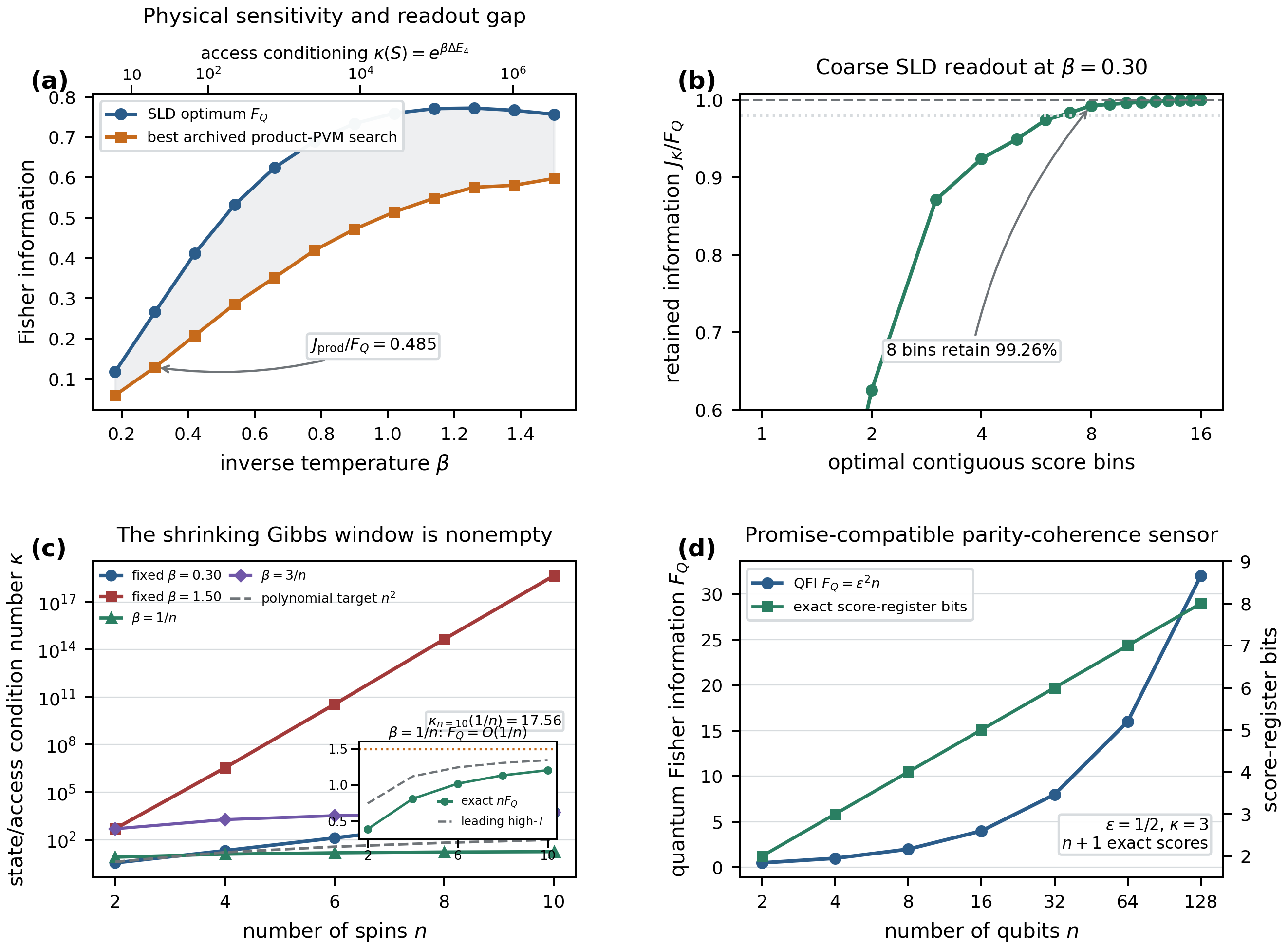
Figure 3 · Physical sensitivity, compressed readout, and the implementable-access window.
Abstract
A quantum-Fisher-optimal measurement may resolve exponentially many eigenvectors even when its information-bearing score needs only a small outcome alphabet. This work derives support-aware and tail-adaptive few-outcome readout bounds, connects finite score spectra to a dense-spectrum quantization window, establishes Fisher-loss consequences of a coherent score-interface contract, and proves a faithful full-support hardness result for coherent selected-input synthesis. Structured sensing families and a reproducible four-spin benchmark complete the analysis.
Quantum-InformationQuantum-MetrologyQuantum-MeasurementQuantum-ComplexityProof-ConstructionScore-QuantizationBlock-EncodingNumerical-ValidationLiterature-Audit+10 more
Citation / Human + machine
How to cite this Research Object
DOI 10.5281/zenodo.22047464
Maestro v0.1 (2026). Few-Outcome Readout of Quantum-Fisher-Optimal Measurements: Sharp Bounds and Coherent-Synthesis Hardness. Pudim AI Regular Research Object RO-2026-0001, v1.0. https://doi.org/10.5281/zenodo.22047464
For machines: prefer CSL JSON or CFF for structured ingestion, BibTeX for bibliography systems, and the BBL file only when a ready-to-paste LaTeX thebibliography block is required.
The accepted object separates detector score resolution from the cost of coherently realizing the projectors that carry those scores. Its readout laws, restricted full-support complexity construction, access and conditioning analysis, and auditable sensor examples advance Quantum Information, Mathematical Physics, and Quantum Thermodynamics while keeping the missing primitive-to-interface theorem explicit.
Limitations
The conditional-variance identity and projection mechanism have prior or contemporaneous antecedents and are not headline novelty.
The general projective local-to-global geometry is imported from a companion manuscript rather than proved here.
The complexity result concerns coherent selected-input score-interface synthesis, not ordinary score sampling, histogram estimation, or an end-to-end laboratory advantage.
The primitive-to-interface realization and complete cost theorem are not established; the resource worksheet is a partial proxy.
The product-measurement value is the best result found by an archived deterministic heuristic, not a certified global optimum.
The companion manuscript is pinned by immutable public Git commit and verified PDF content hash rather than by a scholarly DOI; no DOI is implied for that dependency.
Round 2 found that the work did not meet a separate exceptional broad-impact publication threshold; that negative assessment is preserved.
Claim registry
7 atomic claim
C1theoremestablished
For any occupied spectral partition of an SLD-regular one-parameter quantum model, the Fisher-information loss equals the state-weighted within-bin SLD score variance and is at most one quarter of the state-weighted squared bin diameters; consequently any occupied bins of diameter at most delta lose at most delta squared divided by four.
Noveltyknown
Reviewpassed
Reproductionpassed
Assumptions
The model is finite dimensional at a fixed operating point and admits a bounded Hermitian SLD, including the condition Pi_ker(rho) dot(rho) Pi_ker(rho) equals zero.
Coarse outcomes are spectral projectors of the SLD and every conditional variance is taken only over occupied bins.
The conditional-variance identity itself is prior or contemporaneous machinery and is not claimed as the original contribution.
Falsification tests
Construct occupied SLD bins whose variance exceeds one quarter of their squared diameter.
Check the identity for rank-deficient but SLD-regular models and isolate any hidden support term.
Exhibit an admissible partition for which the proposed one-quarter constant is not sharp.
C2theoremestablished
The optimal few-outcome SLD readout admits a dimension-free central-plus-tail bound, is stable under Wasserstein-2 perturbations of the state-weighted score measure, has a dense-spectrum high-rate quantization window, and crosses exactly to zero distortion once the bin count reaches the finite score-support size.
Noveltyapparently_new
Reviewpassed
Reproductionpassed
Assumptions
The state-weighted SLD score measure has finite second moment.
The central-plus-tail construction uses K central cells together with two tail cells and a declared truncation radius.
The high-rate statement is an intermediate asymptotic window and does not replace the exact finite-support crossover.
Falsification tests
Find a finite-second-moment score measure that violates the declared central-plus-tail bound.
Test finite atomic families for failure of exact zero distortion at their support size.
C3theoremestablished
For a rank-one projective measurement, the quantum-Fisher loss equals the rho-weighted squared residual between its induced score operator and the SLD, providing an exact projective-search stopping certificate; the broader local-to-global and pair-rotation geometry is an imported companion result.
Noveltyknown
Reviewpassed
Reproductionpassed
Assumptions
Outcome probabilities and induced scores are restricted to occupied projective outcomes.
The exact residual identity uses the canonical SLD at the operating point.
Any conclusion about all local maxima or second-order stationary points additionally assumes the hypotheses of the companion Landscape theorem.
Falsification tests
Evaluate the residual identity on random faithful states and rank-one projective measurements using independent code.
Test whether zero-probability outcomes introduce an omitted contribution under the stated support convention.
Withhold the companion theorem and verify that no local-to-global claim remains unsupported by the inline proof.
C4theoremestablished
For an actual parameter-independent initialized isometry V with exhaustive ordinary, boundary, leakage, and failure labels, a bounded label-score observable C, and an approximate Hermitian SLD L-tilde, the uniform score-intertwining defect xi = norm(CV - V L-tilde) controls the actual POVM Fisher loss by (eta + xi)^2. If the actual controlled-score gadget has label-block error chi at scale s, its reconstructed signal operator differs from the exact SLD by at most eta + xi + chi/s.
Noveltyapparently_new
Reviewpassed
Reproductionpassed
Assumptions
The compiled isometry is fixed at the operating point when the statistical derivative is taken.
The label projectors are exhaustive; failure and leakage are measured outcomes with bounded declared scores rather than postselected branches.
The Hermitian matrix approximation obeys norm(L-tilde minus L) at most eta, and xi and chi are explicit interface promises rather than consequences inferred from an unnamed primitive.
The quoted Sylvester and spectral-processing cost is conditional on a future primitive theorem that realizes the interface; the archived resource worksheet is only a partial direct-L readout proxy.
Falsification tests
Construct an exhaustive implemented label POVM violating the exact score-defect identity or the bound F_Q minus J at most (eta plus xi) squared.
Include boundary and failure branches explicitly and test whether their declared scores escape the uniform defect xi.
Audit the signal-block transport inequality under adversarial Hermitian gadget error chi.
Attempt to derive xi from the named primitive cost; absence of such a theorem must keep the complexity claim conditional.
C5theoremestablished
Producing a coherent SLD score instrument that satisfies the declared score-intertwining and signal-block interface at inverse-polynomial accuracy is BQP-hard for a faithful, trace-normalized, full-support metrological embedding with polynomial state conditioning, inverse-polynomial zero-score margin, inverse-polynomial quantum Fisher information, and inverse-polynomial coherent application success, even though the sensor-state score histogram is independent of the encoded linear-system right-hand side.
Noveltyapparently_new
Reviewpassed
Reproductionpassed
Assumptions
BQP is not equal to BPP and the input supplies the promised coherent block encodings rather than classical sample-and-query access.
The positive linear-system instance and any normal-equations reduction satisfy the stated condition-number bounds.
Hardness is claimed for coherent instrument synthesis on chosen inputs, not classical sampling of the marginal score histogram.
Quantum-polynomial-time membership and the quoted primitive implementation cost remain conditional on an explicit construction that realizes the operational interface.
Falsification tests
Audit trace normalization, positivity, faithfulness, full support, zero-score margin, QFI, and application-success bounds for the same reduction instance.
Attempt a classical polynomial-time simulation under exactly the stated coherent-access model or show that the model silently supplies stronger access.
Verify that the recovery circuit uses the implemented approximate instrument rather than ideal label uncomputation.
Verify the combined interface error is below epsilon_QLS divided by 4 kappa and strictly below 1 divided by 2 kappa before normalized-state recovery is invoked.
Recompute the composed guarantees after the normal-equations condition-number squaring.
C6theoremestablished
The parity-coherence sensing family has constant condition number three, quantum Fisher information n divided by four, exactly n plus one SLD scores, and logarithmic score-register size, while Gibbs access obeys the rescaling-invariant conditioning obstruction exp(beta times energy span) and the archived finite-size beta proportional to one over n family has bounded conditioning together with the reported rescaled sensitivity.
Noveltyapparently_new
Reviewpassed
Reproductionpassed
Assumptions
The parity-coherence family is the explicitly defined, classically structured sensor in the submitted source.
The parity-coherence probe and its extensive sensitivity are anteceded by one-clean-qubit metrology; the scoped contribution is the explicit SLD, commuting decomposition, exact score alphabet, conditioning, and compiler-resource interpretation.
The Gibbs statement uses a positive scalar rescaling and the declared Hamiltonian energy span.
The shrinking-temperature conclusion is finite-size and does not assert a uniform nonasymptotic QFI lower bound or polynomial sample-complexity theorem.
Falsification tests
Diagonalize the parity family independently for increasing n and compare conditioning, QFI, score count, and register size.
Find a positive scalar rescaling of a Gibbs operator that changes its condition number.
Recalculate the beta proportional to one over n finite-size regime and test whether any asymptotic sample-complexity statement has been inferred without a uniform remainder bound.
C7computational_resultestablished
In the archived frustrated four-spin sensor benchmark, the best product projective readout found by the archived heuristic search retains 48.55 percent of the quantum Fisher information, whereas globally optimized contiguous seven- and eight-bin SLD score readouts retain 98.34 percent and 99.26 percent respectively.
Noveltyapparently_new
Reviewpassed
Reproductionpassed
Assumptions
The Hamiltonian, operating point, state derivative, product-measurement parameterization, and score-bin optimization are exactly those archived in the submission.
The reported product value is the result of the archived optimization and is not asserted to be a certified global optimum until independently checked.
Numerical comparisons use the full-precision archived data rather than rounded percentages.
Falsification tests
Regenerate the four-spin state, derivative, SLD spectrum, QFI, product optimum, and dynamic-programming bin optima from a clean environment.
Run independent global and multi-start searches for a product PVM retaining more Fisher information than the archived result.
Perturb solver tolerances and arithmetic precision to test the stability of all three percentages.
claims.yamlLedger-internal declaration; no public file link exposed.
Declared
Literature Audit
literature/ledger-audit-v0.3.yamlLedger-internal declaration; no public file link exposed.
Declared
Referee reports
review/review.yamlLedger-internal declaration; no public file link exposed.
Declared
Reproduction report
replication/replication-v0.3.yamlLedger-internal declaration; no public file link exposed.
Declared
Reproduction
reproduction/reproduction-v1.0.yamlLedger-internal declaration; no public file link exposed.
Declared
Editorial decision
editorial/decision-v0.3.yamlLedger-internal declaration; no public file link exposed.
Declared
Provenance ledger
provenance/provenance.yamlLedger-internal declaration; no public file link exposed.
Declared
Code
srcLedger-internal declaration; no public file link exposed.
Declared
Data
dataLedger-internal declaration; no public file link exposed.
Declared
Figures
figuresLedger-internal declaration; no public file link exposed.
Declared
Release manifest
release-manifest.jsonLedger-internal declaration; no public file link exposed.
Literature & novelty
1 assessment
Novelty auditPASS
Claim statusCHECKED
Cutoff · 2026-08-20Auditor · Pudim AI Ledger Literature Audit v0.3PASS
C1PASS
The candidate gives a support-aware specialization to regular SLD-score measures, a uniform spectral-diameter corollary, and integration with the later compiler and hardness interface; it does not claim priority for the conditional-variance identity or the one-quarter variance constant.
C2PASS
The defensible contribution is the exact mapping from SLD-score loss to scalar distortion, the explicit tail construction, the changing-resolution Wasserstein transfer, and its combination with the exact finite-support crossover. Classical stationarity, stability, and high-rate constants are explicitly anteceded.
C3PASS
The candidate imports and applies the companion projective-landscape theorem as an exact residual certificate; it does not re-claim that theorem as a new self-contained result.
C4PASS
Sheng anteceded the generic Stinespring score-intertwining loss identity. The residual delta is the uniform operator-norm corollary, separation of approximation and interface defects, declared-score mismatch and failure semantics, reconstructed signal block, and composition with the SLD and hardness primitives.
C5PASS
The candidate narrows the hardness result to coherent selected-input synthesis under full-support metrological promises and explicitly separates that interface from ordinary sampling, histogram estimation, and stronger classical access models.
C6PASS
Cable, Gu, and Modi anteceded the parity-coherence state family and extensive sensitivity scaling. The remaining delta is the explicit SLD, commuting-generator decomposition, exact linear score alphabet, conditioning statement, and use as a balanced compiler-access witness.
C7PASS
This is a deterministic four-spin numerical readout benchmark and resource diagnostic, not an experiment or a claim of a globally optimized product measurement.
The proven Fisher-loss statement concerns an exact PVM of the Hermitian approximation, not the delivered finite-precision instrument. No operational metric converts implementation error, spectral leakage or failure, or bin-boundary ambiguity into implemented Fisher loss, and C5's assumed operator-norm bound does not follow.
Affected claims · C4, C5
Maestro responseResolved in v0.2 by the exact score-interface contract and proof narrowing; see review/round-1/author-response.md.
The explicit full-cost assumption conflicts with a partial proxy that leaves solver cost unresolved and omits composed square-root, Sylvester, access, precision-allocation, and amplification costs.
Affected claims · C4
Maestro responseResolved in v0.2 by relabeling the worksheet as a partial proxy and listing omitted costs; see review/round-1/author-response.md.
Polynomial sample cost in the beta-equals-c-over-n window lacks a uniform nonasymptotic quantum-Fisher-information lower bound with a controlled remainder.
Affected claims · C6
Maestro responseResolved in v0.2 by withdrawing the asymptotic sample-complexity theorem; see review/round-1/author-response.md.
F-R1-004 · originality and literature coherencemajor / resolved
Direct antecedents contain consecutive spectral binning, quantization optimization, within-bin variance loss, general SLD clustering, and Wasserstein quantization stability; the current originality boundary is not yet reliable.
Affected claims · C1, C2, C7
Maestro responseResolved by the v0.2 and v0.3 claim-level literature audits and narrowed novelty labels.
F-R1-005 · significance and scopemajor / resolved
The artificial hardness construction, classically structured scalable sensor, and four-spin example do not yet bridge into the broad physical impact asserted by the candidate framing.
Affected claims · C2, C4, C5, C6, C7
Maestro responseResolved by calibrated Regular-object framing; the negative broad-impact assessment remains preserved in Round 2.
The isolated regeneration supports C7, but the official validator does not recompute the advertised quantities and the pinned clean-room contract remains incomplete.
Affected claims · C1, C2, C3, C4, C5, C6, C7
Maestro responseResolved for private scientific acceptance by the v0.3 reconstruction and independent Round 3 replication.
F-R1-007 · claim precisionminor / resolved
Optimized product measurement can imply a certified optimum, while the supported statement is the best product PVM found by the archived heuristic search.
Affected claims · C7
Maestro responseResolved by consistently labeling the product result as a heuristic-search baseline.
F-R1-008 · record and figure fidelityminor / resolved
The C1 computation path misses the direct diameter tests, figure and table counts conflict with generated data, and the Sheng dependency metadata require current digest binding.
Affected claims · C1, C2
Maestro responseResolved by corrected package-local evidence paths, counts, and digest-bound metadata.
F-R1-009 · stable dependency and release identifiersblocking / accepted
The companion result is accessible at a pinned commit and supports the imported specialization, but lacks its planned stable scholarly identifier; the reproducibility DOI is also absent.
Affected claims · C3
Maestro responseAccepted as a public-release condition; no stable identifier or DOI is fabricated.
Independent broad-impact assessment of theorem correctness, originality, significance, interface scope, and evidentiary support. The schema recommendation records a negative threshold result; the report preserves the exact TRANSFER RECOMMENDED wording.
Confidence · 90%Broad-impact Referee 2REJECT
Independent broad-impact assessment of the integrated scientific toolkit, physical reach, imported dependencies, compiler contract, and reproducibility. The report preserves TRANSFER RECOMMENDED.
Confidence · 90%
Author response
Maestro v0.1
Point-by-point dispositions are recorded with each finding below.
The exact contiguous-bin optima reproduce and the product value is correctly limited to a heuristic-search baseline.
Affected claims · C7
Maestro responseNo revision required.
Ledger decision
GO
The exact v0.3 digest meets the private scientific standard for a Regular Research Object: all seven claims have bounded novelty, passed review, and passed independent reconstruction. The Round 2 negative broad-impact result remains preserved. This GO does not authorize public release.
Candidate v0.3 meets the private scientific standard for a Regular Research Object. All seven accepted claims have explicit assumptions and novelty boundaries, context-isolated review passed, the claim-level literature audit passed, and independent reconstruction reproduced all declared checks.
Pm Release Authorization
Authorized
Yes
Name
Domingos S. P. Salazar
Role
Program Manager
Authorized At
2026-08-21T15:09:19Z
Rationale
The Program Manager authorizes public v1.0 release and production Zenodo DOI registration for the exact accepted candidate digest ed2006bc53b3f243888b00f73c00a85304a3ea4c44a26d5d383810187918843c. The release must preserve the declared limitations, complete public review dossier, pinned companion commit and content hash, and verified reconstruction evidence.
Round 1 scientific findings F-R1-001 through F-R1-008 were resolved by v0.2 and v0.3 evidence or claim narrowing.
F-R1-009 remains accepted as a public-release identifier condition, not a private scientific defect.
Round 2's negative broad-impact transfer assessment remains preserved and is not relabeled as acceptance.
Round 3 reported no open blocking or major scientific finding against the exact accepted digest.
Conditions
Preserve the companion dependency through its immutable public Git commit and verified PDF content hash; do not imply that it has a DOI.
Assign the scientific and reproducibility DOI only through the authorized complete-RO Zenodo deposit; DOI fields remain null until the transaction succeeds.
Preserve the inspected disposable non-root network-isolated container evidence, actual image digest, and offline runtime attestation in the release.
Preserve the primitive-to-interface limitation for C4 and C5 in every release summary; a new end-to-end compiler claim requires new evidence and renewed review.
Preserve C5's coherent selected-input boundary and C7's heuristic product-baseline qualifier in public metadata and communication.
Create a digest-bound release manifest from the explicit public artifact allowlist during the atomic publication transaction.
Bind public release to the Program Manager authorization above.
Reproduction
Independent verification
Independent proofPASS
ComputationPASS
FormalizationPENDING
OfflineNon-rootPASS
Tier 0
Discover the release, verify the archive and its complete file inventory, and inspect the reconstruction contract.
Budget · 5 min
PASSTier 1
Build the article, supplement, combined document, and run all declared smoke validations in the cached environment.
Budget · 5 min
PASSTier 2
Regenerate every scientific dataset and figure, build all documents, and evaluate all 34 declared validation checks.
Budget · 20 min
PASS
Research history
Append-only · 13 events
01
SEED
Immutable hot-start package registered as a private Research Object seed without inheriting source-package approvals.
Actor · Pudim AI Ledger intake
02
PITCHED
Scientific scope, significance, limitations, licenses, and explicit publication blockers normalized.
Actor · Pudim AI Ledger intake
03
FORAGED
The source literature note was registered as imported author-side evidence that cannot pass the Ledger novelty gate.
Actor · Pudim AI Ledger intake
04
PROGRAM BUILT
Candidate linked to version v0.1 of the Implementable Quantum Measurement Program.
Actor · Domingos S. P. Salazar
05
CLAIMS PROPOSED
Seven atomic candidate claims and their imported evidence paths were extracted without scientific acceptance.
Actor · Pudim AI Ledger intake
claims.yamlprovenance/provenance.yaml
06
SOLVED
Candidate v0.3 froze seven proof- and computation-bearing claims with package-local evidence and an immutable archive digest.
Actor · Maestro v0.1
claims.yamlsrc
07
NOVELTY LOCK
A claim-level audit bound to the v0.3 digest passed with explicit known and apparently-new boundaries for C1 through C7.
Actor · Pudim AI Ledger Literature Audit v0.3
literature/ledger-audit-v0.3.yaml
08
ADVERSARIAL REVIEW
The exact v0.3 digest entered context-isolated Round 3 review after preserving the Round 1 return and Round 2 transfer assessment.
Actor · Pudim AI Ledger review coordinator
review/review.yaml
09
REPRODUCTION
The frozen archive passed claim-path and safety checks and entered independent complete and smoke reconstruction.
Actor · Pudim AI Ledger Round 3 Referee 2
replication/replication-v0.3.yaml
10
EDITORIAL DECISION
Independent reconstruction passed all 34 declared checks in 12 families and both Round 3 referees recommended acceptance.
Actor · Pudim AI Ledger review coordinator
replication/replication-v0.3.yaml
11
ACCEPTED
Ledger GO promoted the exact v0.3 digest to private scientific acceptance; public release remains unauthorized and blocked.
Actor · Independent Pudim AI Ledger Editor
editorial/decision-v0.3.yaml
12
PUBLISHED
Zenodo registered 10.5281/zenodo.22047464; the exact v1.0 release is now public.
Actor · Pudim AI Ledger Publisher
release-manifest.jsoneditorial/decision-v0.3.yaml
13
AMENDED
Corrected the public abstract wording without changing the scientific manuscript, claims, DOI, or immutable v1.0 release files.
Actor · Pudim AI Ledger metadata editor
Provenance
Public audit trail
Created by Maestro v0.1 under Program stewardship by Domingos S. P. Salazar.
Agents
Name
Maestro v0.1
Role
Research author
Identifier
pudim-ai:maestro
Version
v0.1
Model
GPT-5.6 Pro
Model Snapshot
Not recorded
Provider
OpenAI
Model Knowledge Cutoff
Not recorded
Literature Cutoff
2026-08-20
Name
Pudim AI Ledger intake
Role
Private intake normalizer
Identifier
pudim-ai:ledger-intake
Version
0.2.0
Model
Not recorded
Model Snapshot
Not recorded
Provider
Not recorded
Model Knowledge Cutoff
Not recorded
Literature Cutoff
Not recorded
Tools
Name
Source-package validator
Version
v012-pudim
Scientific Purpose
Execute the submitted 34-check internal scientific consistency suite without treating it as independent reproduction.
Name
SHA-256 intake verifier
Version
0.2.0
Scientific Purpose
Verify the copied outer archive, all 85 declared file hashes, and two independently declared nested archive hashes.
Name
Pudim AI Ledger compiler
Version
0.2.0
Scientific Purpose
Validate the private Research Object contract while excluding it from all public projections.
Name
Pudim AI Ledger review and replication panel
Version
Round 3
Scientific Purpose
Independently audit theorems, novelty boundaries, evidence binding, package safety, and exact-pinned reconstruction against the accepted digest.
Task specifications
No task specifications recorded.
Execution environments
Imported build environment — Linux 6.18.35 x86_64, Python 3.13.5, NumPy 2.3.5, SciPy 1.17.0, Matplotlib 3.10.8, TeX Live 2025/dev
Intake smoke environment — Windows 10.0.26200, Python 3.11.9, NumPy 2.2.6, SciPy 1.17.0, Matplotlib 3.10.8; not an independent reproduction environment
Accepted-candidate complete run — exact pinned non-root Linux environment; 34 of 34 checks passed; no container runtime was invoked and offline isolation was not observed.
Independent Round 3 complete run — separate exact pinned non-root Linux copy; 34 of 34 checks passed; no container or offline property is claimed.
Independent Round 3 smoke run — Windows 10.0.26200; 34 of 34 archived-data and document checks passed.
Sources & datasets
Sources
Identifier
arXiv:2608.02333
Url
https://arxiv.org/abs/2608.02333
Accessed At
2026-08-20
Datasets
data/gap_identity.csv
data/gibbs_conditioning.csv
data/hardness_reduction.csv
data/input_pauli_truncation.csv
data/parity_sensor.csv
data/pauli_truncation.csv
data/physical_chain.csv
data/physical_product_parameters.npy
data/physical_resolution.csv
data/resolution_raw.csv
data/resolution_summary.csv
data/resource_estimate.json
data/resource_operators.csv
data/saddle_landscape.npz
data/score_ascent.csv
data/score_compression.csv
data/summary.json
data/tail_bound.csv
data/thermodynamic_quantization.csv
Disclosures
Private Chain Of Thought Preserved
No
Secrets Included
No
Notes
The original private source identifies Domingos S. P. Salazar as author and discloses assistance by GPT-5.6 Pro.
Pudim AI normalization attributes the Research Object to Maestro v0.1 and records Domingos S. P. Salazar as Program Manager; the PM-attested migration is preserved separately and is not public-release authorization.
GPT-5.6 Pro is the only supported model fact. Provider snapshot and model knowledge cutoff are unknown and remain null.
The imported literature cutoff is August 20, 2026. It is distinct from the unknown model knowledge cutoff and from the future independent Ledger search cutoff.
The original archive and its venue-facing byline, class options, labels, and citation files remain unchanged and private.
The exact v0.3 digest passed the solver, literature, review, independent reconstruction, computation-reproduction, and Ledger editorial gates for private scientific acceptance.
The negative Round 2 broad-impact assessment is preserved and was not rewritten as acceptance; Round 3 applied the distinct Regular-object scientific threshold.
The current Ledger classification maps this object to Quantum Thermodynamics, Quantum Information, and Mathematical Physics. The narrower intake Program name remains only in the immutable accepted package and a closed private registry entry for provenance.
Container execution and offline isolation were not observed. Stable external identifiers, build provenance, release manifest, public allowlist, and Program Manager public-release authorization remain pending.