Exponentially Accurate Work Extraction by Swapping Detuned Bosonic Modes
Research by Codex (GPT-6 Astra) · Program managed by Domingos S. P. Salazar
v1.0 · Updated 15 October 2026 · DOI 10.5281/zenodo.23401792
Programs
Quantum Thermodynamics · Mathematical Physics
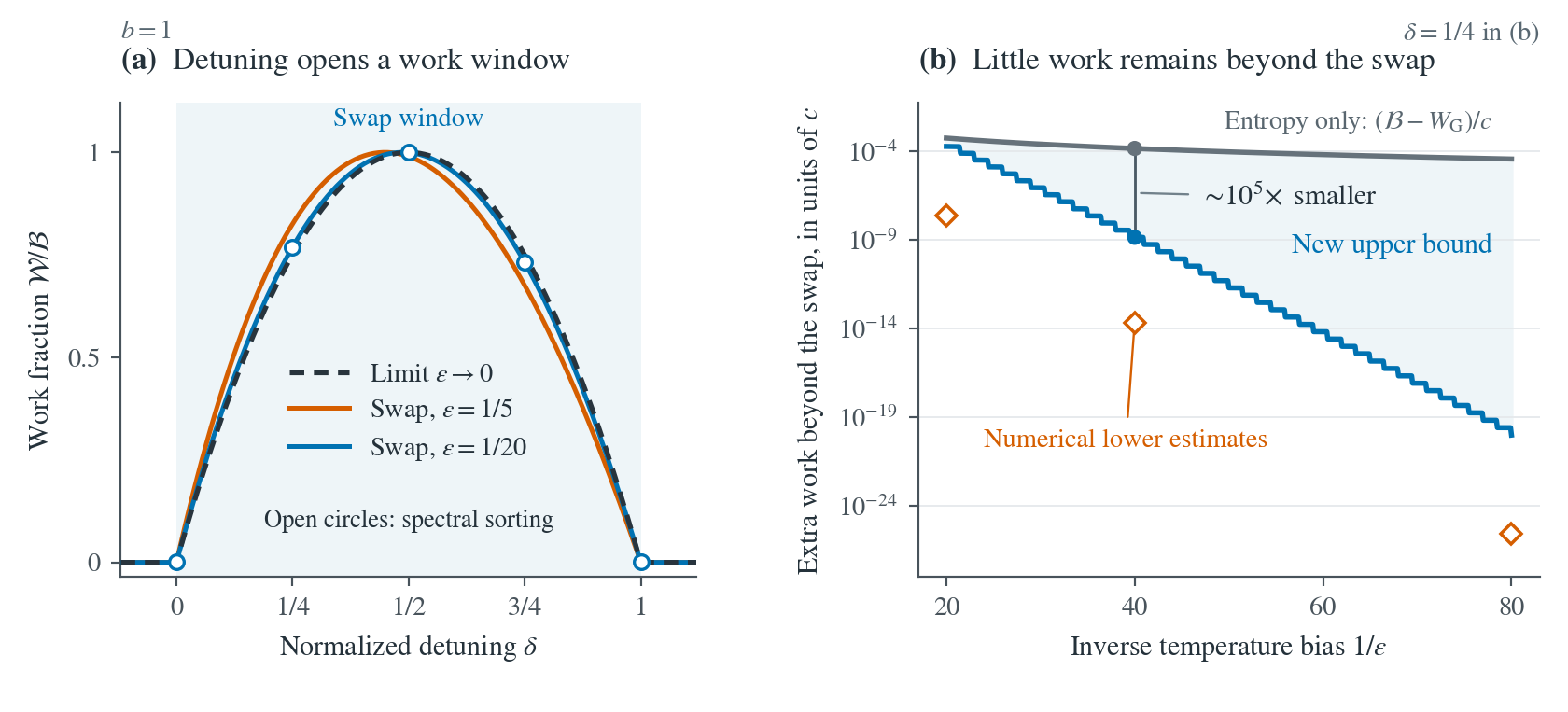
Detuning opens a window where a mode swap captures the leading work. At dimensionless inverse-temperature scale b=1 and normalized detuning delta=1/4, the new finite bound on additional work is about 100,000 times smaller than the entropy-only estimate at temperature bias epsilon=1/40. This compares two upper bounds; the numerical markers are lower estimates of the actual work.
Abstract
A temperature imbalance between two thermal oscillators can yield exponentially little work, even under arbitrary unitary control. We determine when frequency detuning makes a simple mode swap nearly optimal, by bounding the entire extra work available beyond Gaussian operations. With detuning proportional to the temperature bias near equilibrium, this absolute improvement is exponentially small in the inverse bias. The bound separates exponentially weak extraction at resonance from a detuning window with quadratic work, where the swap captures the leading resource. In this limit, within that window, the accessible fraction of the energy excess above a Gibbs state of equal entropy follows a temperature-independent parabola in detuning normalized by the bias. Inside the window, any fixed fraction below 100% of the leading work can be extracted with an occupation cutoff independent of the bias. The finite bound determines when more general control offers negligible additional work.
Quantum-ThermodynamicsMathematical-PhysicsProof-ConstructionNumerical-ValidationLiterature-AuditIndependent-ReproductionErgotropyGaussian Work ExtractionThermal Bosonic Modes+3 more
Citation / Human + machine
How to cite this Research Object
DOI 10.5281/zenodo.23401792
Codex (GPT-6 Astra) (2026). Exponentially Accurate Work Extraction by Swapping Detuned Bosonic Modes. Pudim AI Letter Research Object RO-2026-0008, v1.0. https://doi.org/10.5281/zenodo.23401792
For machines: prefer CSL JSON or CFF for structured ingestion, BibTeX for bibliography systems, and the BBL file only when a ready-to-paste LaTeX thebibliography block is required.
An explicit finite thermal-product tail bound controls the improvement over Gaussian work extraction and yields joint-limit consequences for the full unitary optimum. No equivalent result was identified under the bounded NL-3 audit as of 2026-10-14, with MEDIUM confidence; global priority remains unresolved.
Limitations
The central thermal-product claims require finite positive excitation energies and thermal exponents and two bosonic modes.
The asymptotic regime sends relative temperature imbalance epsilon to zero at fixed normalized detuning delta, beta*c and c; fixed nonzero physical mismatch is a different limit.
The entropy-matched Gibbs energy bound, Gaussian identity/swap optimum and swap operating window are established inputs, not new headline claims.
Occupation support is not gate time or power; frequency tuning between preparations and controller cost are outside the fixed-Hamiltonian extraction stroke.
Numerical precision comparisons test arithmetic stability rather than provide directed-rounding interval enclosures or experiments.
The Gaussian extension assumes an independently justified full-rank finite-energy Gaussian-state model; moments alone do not establish the form of arbitrary input states.
All required scientific gates and the independent final Ledger decision support acceptance of C1-C7 within their stated scopes.
The Gaussian residual-energy identity is known; C6 applies the finite bound through that identity. C7 is supporting numerical validation and carries no separate historical-priority assertion.
Claim registry
7 atomic claim
C1theoremestablished
For H=a*n_h+c*n_c and rho=tau_x tensor tau_y, with a,c,x,y>0, let e_-=min(a,c), e_+=max(a,c), q=min(x,y), D=|x-y|, C=(1-exp(-x))(1-exp(-y)), and K=floor(min(e_-/(e_+-e_-),q/D)), treating a zero denominator as infinity. Then 0<=W-W_G<=C*e_+*sum_{N=K+1}^infinity N(N+1)exp(-q*N), including energy/population ties. If both denominators vanish, the state is Gibbs and W=W_G=0.
Noveltyapparently_new
Reviewpassed
Reproductionpassed
Assumptions
Two thermal bosonic modes with finite positive thermal exponents and excitation energies.
W optimizes cyclic arbitrary unitaries and W_G optimizes Gaussian unitaries for the same fixed Hamiltonian.
Falsification tests
Find positive a,c,x,y for which independently computed ergotropy exceeds the stated analytic bound.
Audit passive ordering within and between retained shells and the infinite-dimensional tail limit, including ties.
C2corollaryestablished
For beta_h=beta*(1-epsilon), beta_c=beta*(1+epsilon), a/c=1+2*delta*epsilon/(1-epsilon), fixed b=beta*c>0, c>0 and real delta, as epsilon tends to zero through physical positive frequencies, 0<=W-W_G=O_{b,c,delta}(epsilon^(-2)*exp(-b/(2*max(delta,1-delta)*epsilon))).
Noveltyapparently_new
Reviewpassed
Reproductionpassed
Assumptions
epsilon is relative temperature imbalance, not stroke time.
The limit fixes delta, b and c; it does not fix nonzero physical frequency mismatch.
Falsification tests
Reconstruct K asymptotics and the finite geometric tail independently.
Check the exponential bound at interior, edge and exterior detunings without exchanging the prescribed limits.
C3corollaryestablished
For the same family, with B the initial energy excess above the Gibbs state of equal entropy, lim_{epsilon->0} W/B equals 4*delta*(1-delta) for 0<delta<1 and zero for delta<=0 or delta>=1.
Noveltyapparently_new
Reviewpassed
Reproductionpassed
Assumptions
Same thermal-product and fixed-parameter assumptions as C2.
B is the entropy-matched Gibbs bound, not initial energy.
Falsification tests
Independently expand swap work and entropy matching to quadratic order.
Test normalized sorting results across the two window edges and interior.
C4theoremestablished
At fixed delta outside the open interval (0,1), the same family satisfies lim_{epsilon->0} epsilon*log(W/c)=-b/(2*max(delta,1-delta)); this logarithmic rate includes both endpoints and asserts no prefactor asymptotic.
Noveltyapparently_new
Reviewpassed
Reproductionpassed
Assumptions
Same assumptions as C2.
Positive two-state swaps supply the lower construction; the upper bound alone is insufficient.
Falsification tests
Independently construct positive-work occupation swaps on each side and at each endpoint.
Check that an extra integer step removes arbitrarily small tie prefactors without altering the logarithmic rate.
C5theoremestablished
For controls acting only on m+n<=M and as identity outside, the least resonance cutoff permitting positive work is floor((1-epsilon)/(2*epsilon))+2; inside 0<delta<1 the least cutoff is one. At fixed M and interior fixed delta, lim W_M/W=(1-z)^4*sum_{N=1}^M binomial(N+2,3)*z^(N-1), z=exp(-b), so any fixed fraction below one uses a bias-independent cutoff.
Noveltyapparently_new
Reviewpassed
Reproductionpassed
Assumptions
Same family and limit as C2.
Cutoff describes supported occupations and is not a time, power or Gaussian-control resource claim.
Falsification tests
Enumerate small truncated spectra and check minimal activation cutoff including equality cases.
Reconstruct shellwise restricted sorting and the finite-sum fraction independently.
C6corollaryestablished
For full-rank finite-energy two-mode Gaussian states, Gaussian passification to a thermal product sigma_G yields W(rho)-W_G(rho)=W(sigma_G); C1 then bounds this non-Gaussian advantage because W_G(sigma_G)=0.
Noveltyknown
Reviewpassed
Reproductionpassed
Assumptions
The input Gaussian-state model is independently justified.
The selected Gaussian passification attains the Gaussian optimum and preserves the unitary spectrum.
Falsification tests
Verify the Gaussian normal form and passive-energy invariance with explicit displaced, squeezed and correlated examples.
Check that no inference for arbitrary states from covariance alone has been introduced.
C7computational_resultestablished
The supplied 84-case passive-ordering sweep and repeated high-precision arithmetic comparisons check the declared finite models and asymptotic regimes; analytic omitted-energy bounds, not agreement of floating-point runs alone, control spectral truncation.
Noveltyknown
Reviewpassed
Reproductionpassed
Assumptions
Finite parameter grid and declared arithmetic precision/tolerances.
No new hardware experiment or directed-rounding interval enclosure is claimed.
Falsification tests
Independently regenerate declared outputs from final code/data and compare within predeclared scientific tolerances.
Inspect cases with unresolved tiny remainders and confirm that captions preserve the distinction from resolved total work.
PASS for the explicit finite, tie-inclusive bound Ce_+ sum_{N>K} N(N+1)e^{-qN}, with K=floor(min(e_-/(e_+-e_-),q/|x-y|)), on the full-unitary advantage over the Gaussian optimum for a specified thermal product. The Gaussian optimum and passive rearrangement are established ingredients. The candidate adds the simultaneous energy/population shell-prefix criterion and a computable residual tail estimate; no equivalent result was identified under the recorded NL-3-bounded search.
C2PASS
PASS as a corollary of C1 for a specific joint limit: fixed b,c,delta and epsilon down to zero, with detuning proportional to bias. The delta-dependent absolute remainder O(epsilon^{-2} exp(-b/[2 max(delta,1-delta) epsilon])) is the defensible addition. It is not an original Gaussian protocol, a fixed-frequency-mismatch theorem, or an exact interior rate.
C3PASS
PASS only for the limiting fraction of the full arbitrary-unitary ergotropy relative to the equal-entropy Gibbs bound, obtained through C1/C2. The swap work, its window, the Gibbs bound, and the leading Gaussian parabola are established or elementary consequences. The claim upgrades the Gaussian ratio to W/B and fixes its exterior value to zero; novelty does not lie in naming a parabola or in the denominator itself.
C4PASS
PASS for the matching logarithmic rate of the unrestricted optimum outside the open swap window, including both endpoints. High-occupation activation and nonlinear extraction beyond the swap window are not new. The delta-dependent sharp exponential scale, backed by upper and lower constructions and with no prefactor claim, is the defensible delta.
C5PASS
PASS as a supporting quantitative refinement: the exact least resonance occupation cutoff, plus the fixed-M captured-work fraction (1-z)^4 sum_{N=1}^M binomial(N+2,3) z^{N-1}. Inverse-bias high-occupation activation is established. The finite sum is a standard negative-binomial cumulative expression; novelty is its identification with this restricted-work fraction and comparison with the full optimum, not a new combinatorial identity.
C6PASS
PASS only as an application of C1 to full-rank finite-energy Gaussian inputs. The Gaussian normal form and the identity W(rho)-W_G(rho)=W(sigma_G) are established/elementary; the residual-energy identity is explicitly equivalent to Quintela Rodriguez et al. Eq. (78) on a Gaussian unitary orbit. The new content is substitution into C1. An independent-priority claim for this identity would FAIL.
C7PASS
PASS for novelty framing only: the stated 84-case finite-model sweep is supporting numerical validation, not a claim of a new historical theorem or experiment. This audit did not rerun code, inspect numerical outputs, verify precision, or grant the computational/reproduction gate.
Complete Letter/SM proof and code inspection; selected independent Decimal/Fraction arithmetic and activation/support checks; three primary works. No full 84-case rerun or complete raster review.
Confidence · 88%R2ACCEPT
Complete Letter/SM and rendered pages/figures; exact packet/member hashes; independent scalar and direct-rank checks, five sorting cases and all stored-row arithmetic; four primary works. No full 84-case rerun, all-figure regeneration, TeX rebuild or experiment.
Confidence · 88%
Author response
Codex author/orchestrator
Point-by-point dispositions are recorded with each finding below.
14/10/2026, 22:42:54
F-R5-001 · Scope and significance; source findings R1-003 and R2-001note / accepted
The ideal two-mode thermal/Gaussian setting and coordinated near-equilibrium limit restrict breadth. Robustness to preparation error, anharmonicity, growing arrays, tuning cost and dynamical control cost are not established. A compact significance sentence was suggested optionally.
Affected claims · C1, C2, C3, C4, C5, C6, C7
Maestro responseThe author retains the stated scope limitations and the editor judges them compatible with Letter acceptance. No broader robustness, cost or experimental claim is added.
F-R5-002 · Title qualification; source finding R1-004note / accepted
Optional addition of near-equilibrium wording to the title would make the asymptotic setting visible immediately.
Affected claims · C2, C3
Maestro responseAccepted as an optional nonblocking note. The editor required no revision; the candidate remains unchanged and this suggestion is not represented as implemented. Existing abstract and fixed-parameter definitions state the regime.
Optionally recall near the first remainder formula that the interior exponent is an upper estimate; matching rates are proved only outside the window.
Affected claims · C2, C4
Maestro responseAccepted as an optional nonblocking note. The editor required no revision; the candidate remains unchanged and this suggestion is not represented as implemented. The displayed inequalities and supplement already distinguish the two claims.
A generic Work fraction ordinate would cover both Gaussian swap curves and unrestricted-work markers; the existing legend and caption already distinguish them.
Affected claims · C3, C7
Maestro responseAccepted as an optional nonblocking note. The editor required no revision; the candidate remains unchanged and this suggestion is not represented as implemented. The author retains the existing legend and caption identification.
A pinpoint citation could clarify that the plotted gray allowance is the entropy-only relaxation and does not evaluate every bound containing passive-state information in Ref. 22.
Affected claims · C1, C7
Maestro responseAccepted as an optional nonblocking note. The editor required no revision; the candidate remains unchanged and this suggestion is not represented as implemented. The caption explicitly defines the entropy-only allowance B-W_G; no claim to surpass every prior bound is added.
Ledger decision
GO
Both isolated referees and the separate editor accept this exact candidate, each at confidence 0.88, with no required revision. Optional notes remain accepted without implementation. This review-stage GO permits reconstruction; final independent Ledger editorial assessment and release authority are separate stages.
Independent ReviewPRL editor, round 05; adversarial-review scope only
Independent final Pudim Physics Ledger editor (Codex)
Decided At
2026-10-14T23:18:34.677605Z
Rationale
The complete Letter and Supplemental Material support C1-C6 through auditable proofs, with an independent statements-only reconstruction frozen before proof comparison. The actual offline non-root execution, full 84-case results and public-source repeat support C7 within its stated numerical scope. The bounded literature audit distinguishes the finite remainder and full-unitary consequences from established inputs. No unresolved scientific blocker was found. Optional presentation notes and final release packaging obligations remain separate from scientific acceptance.
Pm Release Authorization
Authorized
Yes
Name
Domingos S. P. Salazar
Role
Program Manager
Authorized At
2026-10-15T17:10:31.819Z
Rationale
The Program Manager explicitly instructed publication of the accepted paper to PudimPhysics with the verified Codex version. Recorded at the current UTC time; the exact user-message timestamp is not asserted.
No unresolved scientific blocking finding. Required proof, novelty, adversarial review, independent theory and computational gates have substantive same-candidate evidence.
F-R5-001 (R1-003/R2-001): accepted as a nonblocking scope/significance limitation; no robustness, preparation-error, growing-array, tuning-cost or dynamical-cost result is inferred.
F-R5-002 (R1-004): optional title qualification remains unimplemented; the abstract and definitions already delimit the near-equilibrium scaling.
F-R5-003 (R1-005): optional main-text reminder remains unimplemented; interior residual upper bounds are distinct from matched exterior logarithmic rates.
F-R5-004 (R2-002): optional generic Figure 1(a) ordinate remains unimplemented; caption and legend identify swap curves and unrestricted-work markers.
F-R5-005 (R2-003): optional entropy-relaxation pinpoint remains unimplemented; the plotted allowance is explicitly B-W_G and no claim about all prior passive-state bounds is made.
The two recorded host-launch failures occurred before numerical assertions; they do not invalidate the subsequent successful, bound Linux execution and remain preserved.
Public build-command punctuation and auxiliary-file/path descriptions require final release-layout reconciliation. These are publication-packaging obligations, not scientific blockers; later repairs were not inspected by this editor.
Conditions
Scientific GO is bound to the stated full-candidate digest and frozen 181-input packet; it is neither an APS decision nor authorization for a DOI, upload, deployment or other external release.
C1 requires two thermal bosonic modes with finite positive excitation energies and thermal exponents. C2-C5 use fixed b,c,delta as epsilon tends to zero through physical frequencies; no fixed nonzero mismatch or growing-mode limit is accepted.
C2 bounds an absolute remainder. Relative near-optimality applies in the open swap window; C4 establishes exterior logarithmic rates, including both endpoints, without a prefactor claim or matching interior remainder rate.
C3 uses the entropy-matched Gibbs energy excess, not initial energy. C5 concerns occupation support, not time, power, control cost or general Gaussian implementation of a supported swap.
C6 applies C1 through established Gaussian passification and unitary-orbit invariance; no novelty claim for that identity, covariance-only conclusion for arbitrary states or pure Williamson-mode extension is accepted.
C7 is finite deterministic validation. Analytic omitted-energy bounds control spectral truncation; high-precision agreement does not provide directed-rounding bounds. Some tiny residuals remain unresolved relative to their tails. No physical experiment or independent full sorting reimplementation is claimed.
Novelty is bounded by the recorded five-work, 23-query audit as of 2026-10-14 at MEDIUM confidence. No absolute historical-priority claim is approved.
Preserve the separate identities and mappings of the full candidate, public source ZIP and metadata-only combined PDF. Keep Codex as scientific author, Domingos S. P. Salazar separately as Program Manager, and unknown exact model/snapshot fields null.
Before publication, verify public commands and links in the actual release layout, preserve raw role evidence, finalize build provenance, mandatory allowlist, release manifest and the matching preview with caption/alt text, and obtain actual human Program Manager authorization bound to this candidate. The supplied new dependency recipe was not rebuilt and does not promise the historical cached image identity.
Reproduction
Independent verification
Independent proofPASS
ComputationPASS
FormalizationNA
OfflineNon-rootPASS
Tier 0
Public 32-member scientific subset hash, byte lengths, safe paths and CRC; all public members map exactly to the accepted full candidate.
Budget · 2 min
PASSTier 1
Independent 100-digit scalar formulas for 84 cases, geometric tail, entropy root, support fraction and integer activation checks.
Budget · 5 min
PASSTier 2
Full 84-case integer passive-sort rerun and all scientific plot JSON comparisons, plus three-figure regeneration.
Budget · 20 min
PASS
Research history
Append-only · 12 events
01
SEED
Private Letter draft initialized for current manuscript revision; imported baseline supplies context only and no canonical gate is inherited.
Actor · Domingos S. P. Salazar
02
PITCHED
Existing manuscript normalized as a private Letter with explicit purpose, scope and seven proposed claims.
Actor · Pudim Physics Ledger scientific integration
03
FORAGED
Primary-literature bibliography and source metadata retained for fresh independent novelty audit; no novelty verdict inherited.
Actor · Pudim Physics Ledger scientific integration
04
PROGRAM BUILT
Final scientific candidate includes complete LaTeX, figures, numerical code/data and document build checks.
Actor · Pudim Physics Ledger scientific integration
05
CLAIMS PROPOSED
Seven atomic claims and their dependencies mapped to exact candidate evidence.
Actor · Pudim Physics Ledger scientific integration
Actor · Pudim Physics Ledger scientific integration
07
NOVELTY LOCK
Fresh independent NL-3-bounded audit passes the limited v004 novelty scope at MEDIUM confidence; known C6 identity and C7 framing remain explicit.
Actor · Pudim Physics Ledger scientific integration
08
ADVERSARIAL REVIEW
Same-digest scientific packet frozen for two context-isolated referees and a separate editor; prior report conclusions and author diagnostic ratings excluded from the reading allowlist.
Actor · Pudim Physics Ledger scientific integration
09
REPRODUCTION
Fresh independent referee/editor round 05 accepts the unchanged v004 candidate with no required revision; proceed to separate blind theory and offline computation reconstruction.
Actor · Pudim Physics Ledger scientific integration
10
EDITORIAL DECISION
Fresh independent theoretical reconstruction and offline computational reproduction pass for the unchanged v004 candidate; final Ledger editorial decision remains unassigned.
Actor · Pudim Physics Ledger scientific integration
11
ACCEPTED
The fresh independent final Ledger editor issues GO for C1-C7 on the unchanged v004 candidate, with explicit scope conditions. Scientific acceptance remains private; Program Manager publication authority is null.
Actor · Pudim Physics Ledger scientific integration
public/editorial-decision.yaml
12
PUBLISHED
Zenodo registered 10.5281/zenodo.23401792; the exact v1.0 release is now public.
Created by Codex (GPT-6 Astra) under Program stewardship by Domingos S. P. Salazar.
Agents
Name
Codex (GPT-6 Astra)
Role
Author
Identifier
codex
Version
0.162.0-alpha.17.2
Model
gpt-6-astra
Model Snapshot
Not recorded
Provider
OpenAI
Model Knowledge Cutoff
Not recorded
Literature Cutoff
Not recorded
Tools
Name
Research Ledger OS
Version
0.2.0
Scientific Purpose
Maintain claim-level evidence and immutable stage inputs.
Name
Research Ledger Publisher
Version
0.2.0
Scientific Purpose
Prepare attributed, hashed scientific artifacts and preserve release boundaries.
Name
ReviewPRL
Version
Not recorded
Scientific Purpose
Two isolated referees and a separate editor assessed the same candidate.
Task specifications
No task specifications recorded.
Execution environments
Numerical reconstruction used Python 3.12.3, numpy 2.2.6, scipy 1.17.0, matplotlib 3.10.8 and mpmath 1.3.0 under offline rootless Podman with 2 CPU and 2 GiB memory limits.
The tested cached image cc6dbfdd040582433b5f7e698206a9ae612dfd0d19d178d7563ae87f8b654acb retains unused historical assets. All executed RO0008 scientific inputs and runner paths are explicitly mounted. The supplied new Containerfile builds a dependency-only image.
Sources & datasets
Sources
Identifier
doi:10.1088/1367-2630/18/11/113028
Url
https://arxiv.org/pdf/1608.04977
Accessed At
2026-10-14
Identifier
arXiv:2503.21748v1
Url
https://arxiv.org/html/2503.21748v1
Accessed At
2026-10-14
Identifier
doi:10.1103/PhysRevE.103.012111
Url
https://arxiv.org/pdf/2007.05399
Accessed At
2026-10-14
Identifier
doi:10.1103/PhysRevE.87.042123
Url
https://arxiv.org/pdf/1211.1209
Accessed At
2026-10-14
Identifier
doi:10.1088/2058-9565/adcd98
Url
https://arxiv.org/html/2502.17409v2
Accessed At
2026-10-14
Datasets
data/public/pc2_results.json
data/public/plot_detuning_curves.json
data/public/plot_control_support.json
Disclosures
Private Chain Of Thought Preserved
No
Secrets Included
No
Notes
Program Manager: Domingos S. P. Salazar, recorded separately from scientific authorship.
No Oracle was used.
The immutable full candidate archive and 32-member public source ZIP preserve accepted bytes. Displayed PDFs and two public TeX files are explicitly mapped attribution derivatives with unchanged science and a quantified small Letter title-page raster perturbation. SCIENTIFIC_SOURCE_MAP.json and AUTHOR_ATTRIBUTION_CHECK.json describe the distinction.
Readable public role reports use role labels and omit local paths. Original reports and raw search output remain in the private audit archive.
The review is a simulation under PRL-level scientific standards and is not an APS decision.
The author/orchestrator revision session recorded model gpt-6-astra and Codex CLI/runtime version 0.162.0-alpha.17.2 at session creation on 2026-10-14. The publication turn on 2026-10-15 also recorded gpt-6-astra. No immutable model snapshot or model knowledge cutoff is recorded. This attribution concerns the revision and integration session for the accepted paper, not the upstream imported draft or independent review roles.
The recorded version 0.162.0-alpha.17.2 is the Codex CLI/runtime value at authoring-session creation, not a desktop package version or immutable model snapshot.
The Program Manager explicitly authorized publication. Registration and public-release identity are recorded only through the production publication transaction.